An Astralis Technology analysis of official ICO data security incident trends, January 2019 to September 2026.
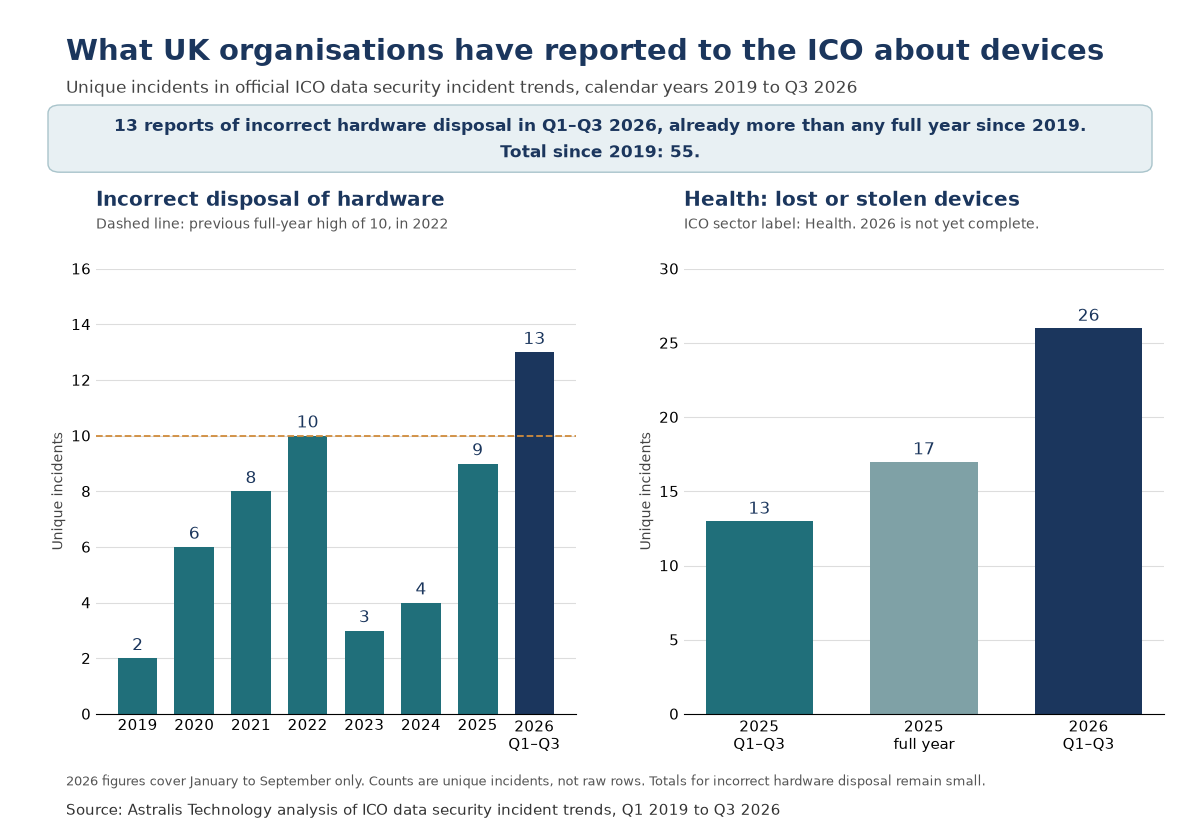
The Information Commissioner’s Office (ICO) recorded 13 reports of “incorrect disposal of hardware” in January to September 2026, already more than the previous annual high of 10, in 2022, and the highest annual figure since the ICO’s published records began in 2019. There have been a total of 55 such reports since 2019, with three months of 2026 still to be counted. Over the same period, organisations in the ICO’s Health sector have reported more lost or stolen devices containing personal data than in the whole of last year.
Key facts
The ICO recorded 13 reports of “incorrect disposal of hardware” in January to September 2026, already more than in any full year since the ICO’s published records began in 2019, when the previous annual high was 10, in 2022. Source: Astralis Technology analysis of ICO data security incident trends, Q1 2019-Q3 2026.
There have been a total of 55 reports of incorrect disposal of hardware to the ICO since 2019. Source: Astralis Technology analysis of ICO data security incident trends, Q1 2019-Q3 2026.
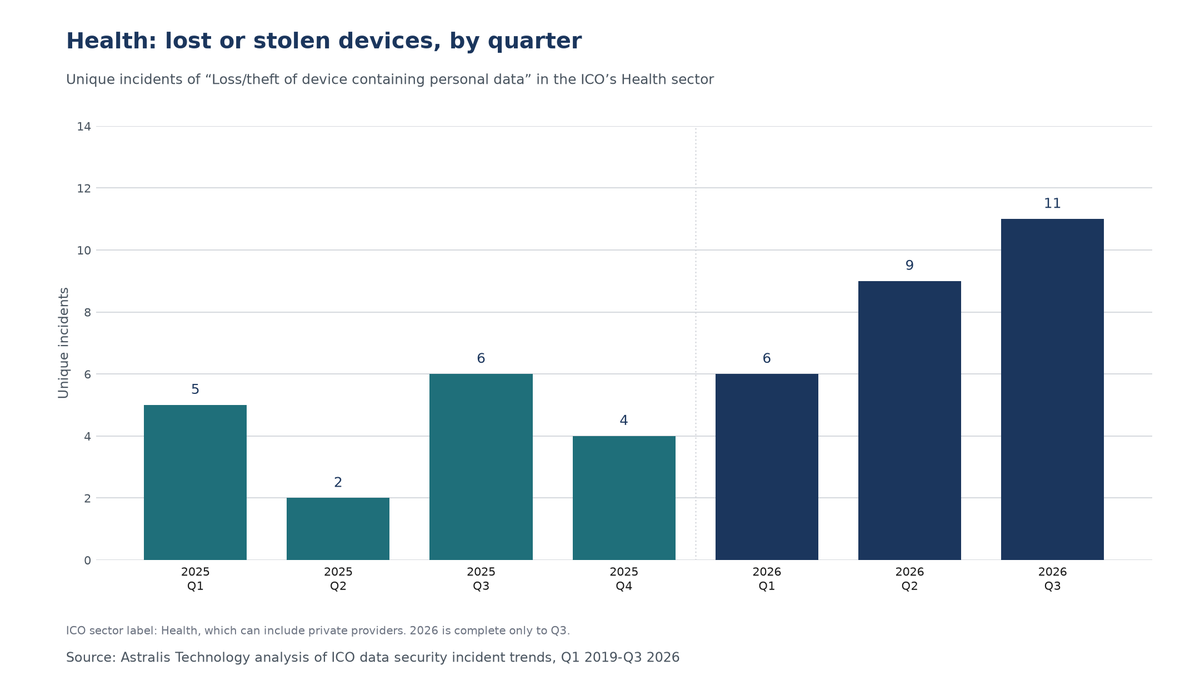
Organisations in the ICO’s Health sector reported 26 lost or stolen devices containing personal data in January to September 2026, compared with 17 in the whole of 2025 and 13 in January to September 2025. Reports in 2026 rose by quarter: 6, 9 and 11. Source: Astralis Technology analysis of ICO data security incident trends, Q1 2019-Q3 2026.
Education and childcare was the largest sector for lost or stolen device reports, with 36 of 155 reports in 2025 and 30 of 133 in January to September 2026 (29 in the same period of 2025). Source: Astralis Technology analysis of ICO data security incident trends, Q1 2019-Q3 2026.
Lost or stolen device reports overall were 189 in 2023, 186 in 2024 and 155 in 2025, with 133 in January to September 2026 compared with 124 in the same period of 2025. The like-for-like rise in this type is concentrated in Health. Incorrect disposal of hardware is a separate, smaller official category, already at its highest annual figure since 2019. Source: Astralis Technology analysis of ICO data security incident trends, Q1 2019-Q3 2026.
Journalists and researchers: how to cite this research, including reuse of the charts, is at the end of this page.
“These figures are small, but they are moving in the wrong direction, and they only capture what organisations have discovered and reported. For any organisation running thousands of endpoints, the exposure sits in the transitions: devices that are reassigned, returned, stored or retired. Boards should expect the same rigour at end of life as at deployment: an accurate asset register, an auditable chain of custody, and certified evidence that every device has been sanitised or destroyed.”
Laura Cooper, CMO & Co-Founder, Astralis Technology
What this means for IT, security and procurement leaders
End of life is a security event, not a logistics task. Incorrect disposal reports remain uncommon in the ICO data, but 2026 has already recorded 13 reports in January to September, more than in any full year since the ICO’s published records began in 2019. The official category covers computers, laptops or other devices not fully cleared of personal data, and not otherwise anonymised or encrypted, before disposal.
Knowing where each device is remains the foundation. Lost-device reports and disposal failures often point to the same gap: not being able to say where each device is, and what state its data is in. In the ICO’s Health sector, lost or stolen device reports in January to September 2026 have already passed the whole of 2025, and have risen quarter by quarter.

Those Health reports rose in each quarter of 2026: 6 in Q1, 9 in Q2 and 11 in Q3.
Evidence matters as much as process. Under the UK GDPR accountability principle, organisations must not only protect personal data but be able to demonstrate that they have done so. For retired IT, that means a documented chain of custody and a certificate of sanitisation or destruction for every device, not just an assurance from a contractor.
Reported figures understate the picture. The ICO file reflects incidents that were discovered and then reported. A device that leaves an estate with recoverable data and is never traced will not appear in these numbers.
An end-of-life checklist
- Maintain a live asset register for every device and drive, from procurement to retirement, with named ownership at each stage.
- Encrypt by default so a lost or stolen device is far less likely to become a reportable breach.
- Control the transition points — leavers, refresh programmes, office moves, data centre exits and returns from repair — where assets most often fall out of view.
- Require an auditable chain of custody from collection to sanitisation or destruction, reconciled to your register at serial level.
- Insist on certified data sanitisation or destruction, and retain a certificate for every device.
- Hold your suppliers to the same standard, and audit them. Accountability for the data stays with you.
- Have a clear escalation route so a lost, stolen or incorrectly disposed device is reported internally at once and assessed for ICO notification.
Related guidance
FAQs
How many incorrect hardware disposal reports has the ICO recorded in 2026 so far?
The ICO recorded 13 reports of “incorrect disposal of hardware” in January to September 2026. That is already more than in any full year since the ICO’s published records began in 2019, when the previous annual high was 10, in 2022. Three months of 2026 remain to be counted. Source: Astralis Technology analysis of ICO data security incident trends, Q1 2019-Q3 2026.
How common are these reports?
They remain uncommon. There have been a total of 55 reports of incorrect disposal of hardware to the ICO since 2019. Source: Astralis Technology analysis of ICO data security incident trends, Q1 2019-Q3 2026.
What does the ICO mean by incorrect disposal of hardware?
The official category covers computers, laptops or other devices not fully cleared of personal data, and not otherwise anonymised or encrypted, before disposal. Source: ICO, incident types glossary.
Have lost or stolen device reports increased in Health?
Organisations in the ICO’s Health sector reported 26 lost or stolen devices containing personal data in January to September 2026, compared with 17 in the whole of 2025 and 13 in the same nine months of 2025. Reports rose in each quarter of 2026: 6, 9 and 11. “Health” is the ICO’s sector label and can include private providers. Source: Astralis Technology analysis of ICO data security incident trends, Q1 2019-Q3 2026.
Are lost or stolen devices rising across all sectors?
Overall reports have been broadly stable: 189 in 2023, 186 in 2024 and 155 in 2025, with 133 in January to September 2026 compared with 124 a year earlier. Education and childcare remains the largest sector for this type. Source: Astralis Technology analysis of ICO data security incident trends, Q1 2019-Q3 2026.
About this data
Astralis Technology counted unique incidents, not raw rows, in the ICO’s official data security incident trends file. Some incidents appear on more than one row, for example where several data types are involved.
- Source: ICO, Data security incident trends, reports received up to Q3 2026. The ICO says the data starts at Q1 2019 because incidents were recorded differently before then.
- File: data-security-incidents-trends-download-q1-2019-to-q3-2026.csv (ICO page updated 26 October 2026; file last-modified 28 October 2026).
- Incident types and sector names are the ICO’s own. Official definitions are in the incident types glossary. “Health” can include private providers. Sectors have not been combined into wider groupings.
- “Loss/theft of paperwork or data left in insecure location” relates to paper records and is excluded from the device figures.
- 2026 figures cover January to September only. Later ICO releases can revise earlier periods slightly. The 2025 lost-or-stolen-device total is 155 in this file, against 154 in the ICO’s Q4 2025 release. The 2025 Health (17), Education and childcare (36) and hardware-disposal (9) totals were unchanged.
- The ICO notes that the file contains only incidents “that were discovered and then reported to the ICO.” Under specific circumstances some cases are transferred to a separate system for review; these “may include some of the larger and more serious breaches” and are not in this file.
How to cite this research
Source: Astralis Technology analysis of ICO data security incident trends, https://astralistech.co.uk/ico-incorrect-hardware-disposal-and-lost-devices-2026/.
The charts may be reused with that credit and a link to this page.