The Enterprise Guide to Technology Refresh Programmes
Every organisation depends on technology. From laptops and mobile devices to servers, networking equipment and cloud-connected infrastructure, technology enables employees to work, customers to be served and organisations to operate securely and efficiently.
However, no technology lasts forever.
Hardware reaches the end of its supported life. Operating systems become obsolete. Security risks increase. Performance declines. User expectations evolve. New ways of working emerge. Regulatory requirements change. Business priorities shift.
Technology refresh programmes exist to manage that change.
While many organisations view technology refresh simply as replacing ageing equipment, successful enterprises recognise it as something much broader. A well-planned technology refresh programme protects information, supports productivity, improves resilience, strengthens governance and enables organisations to adapt confidently to changing business requirements.
Poorly planned refresh programmes can introduce unnecessary risk, increase costs, disrupt operations and expose organisations to security and compliance failures. Well-managed programmes achieve the opposite – reducing operational risk while creating opportunities to improve efficiency, enhance user experience and maximise value throughout the technology lifecycle.
This guide explains how enterprise organisations approach technology refresh strategically, from initial planning through deployment, governance, secure retirement and continual improvement.
Executive Summary
Technology refresh programmes are no longer simply about replacing ageing hardware. They have become strategic initiatives that influence cybersecurity, business continuity, employee productivity, governance, financial planning and organisational resilience.
Successful organisations manage technology refresh as an ongoing lifecycle rather than a series of isolated replacement projects. They understand their technology estate, establish clear governance, protect sensitive information throughout the refresh process and maximise value from retiring assets.
This guide explains the principles, governance and best practices that help organisations plan and deliver successful enterprise technology refresh programmes while supporting long-term operational performance.
What Is a Technology Refresh Programme?
A technology refresh programme is the structured process of planning, replacing, redeploying and securely retiring technology assets throughout their lifecycle. Rather than reacting to ageing equipment or unexpected failures, organisations establish planned refresh cycles that align technology investment with business objectives, information security requirements and operational needs.
Technology refresh programmes typically include:
- Assessing existing technology assets and lifecycle status.
- Identifying equipment approaching end of support or end of life.
- Planning future technology requirements.
- Procuring replacement devices and infrastructure.
- Deploying new technology with minimal operational disruption.
- Securely sanitising or destroying data from retired assets.
- Reusing, redeploying or reselling suitable equipment.
- Recycling equipment that has reached the end of its useful life.
- Producing auditable records that demonstrate governance and compliance.
Importantly, technology refresh is not a single event. It is an ongoing lifecycle discipline that helps organisations maintain secure, productive and resilient technology environments.
Technology Refresh Is a Business Strategy – Not Just an IT Project
One of the most common misconceptions is that technology refresh belongs solely to the IT department.
In reality, successful refresh programmes involve multiple business functions working together towards shared organisational objectives.
IT teams focus on infrastructure, deployment and operational continuity.
Information Security teams ensure sensitive data remains protected throughout the lifecycle and that retired assets are managed securely.
Procurement manages supplier selection, budgeting, contracts and purchasing strategies.
Finance evaluates investment decisions, depreciation schedules and value recovery opportunities.
Operations help minimise disruption to business activities during deployment.
Compliance and governance teams ensure organisational policies, regulatory obligations and audit requirements are maintained throughout the programme.
Senior leadership provides strategic direction, investment approval and organisational sponsorship.
When these stakeholders collaborate through a structured governance framework, technology refresh becomes more than an equipment replacement exercise. It becomes an enabler of organisational resilience, security, productivity and long-term digital transformation.
The Enterprise Technology Refresh Framework
Successful technology refresh programmes rarely happen by accident. They are the result of careful planning, clear governance and well-defined processes that extend far beyond the purchase of replacement equipment.
While every organisation has different priorities, the most effective programmes share a common structure. They move through a series of connected stages that align technology decisions with business objectives, minimise operational disruption and ensure every asset is managed responsibly throughout its lifecycle.
Throughout this guide we use the Enterprise Technology Refresh Framework to illustrate how mature organisations plan, govern and continually improve technology refresh programmes. Rather than representing a rigid methodology, it provides a practical structure that can be adapted to organisations of different sizes, sectors and operational requirements.
Rather than treating technology refresh as a one-off project, the framework encourages organisations to think of it as a continuous lifecycle, where every stage informs the next.
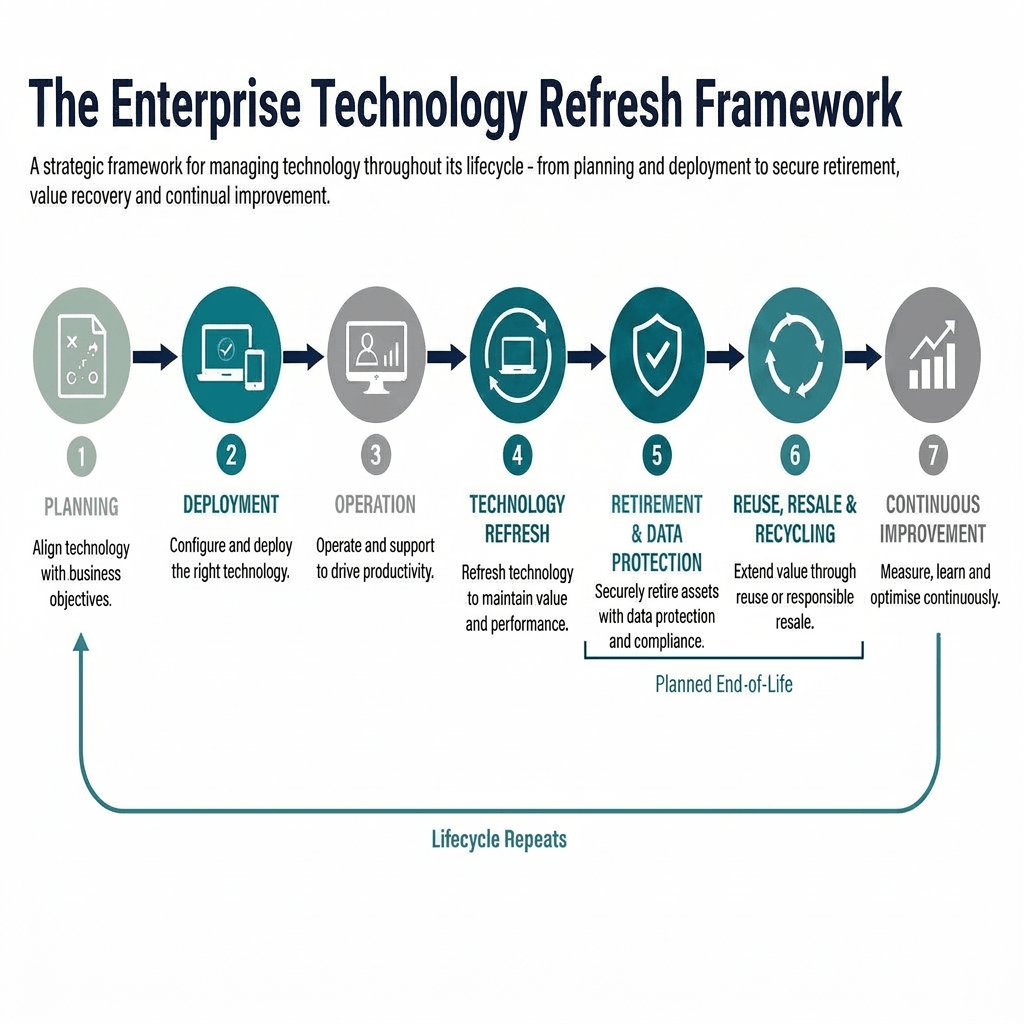
Stage 1 – Assess
Every successful technology refresh programme begins with understanding the current environment.
Surprisingly, many organisations cannot accurately answer fundamental questions such as:
- What technology assets do we own?
- Where are they located?
- How old are they?
- Which devices present the greatest operational or security risk?
- Which assets are approaching end of manufacturer support?
- Which assets still retain commercial value?
Without reliable asset intelligence, organisations are forced to make decisions based on incomplete information, often resulting in unnecessary expenditure, inconsistent user experiences and avoidable operational risk.
An effective assessment phase establishes a clear understanding of the technology estate by reviewing:
- Hardware age and condition.
- Operating system and software support status.
- Security vulnerabilities.
- Performance and reliability.
- Warranty and maintenance information.
- User requirements.
- Business criticality.
- Existing lifecycle policies.
This information provides the evidence needed to prioritise investment, forecast future refresh cycles and build a business case that aligns technology spending with organisational objectives.
Technology refresh should never begin with purchasing new equipment.
It begins with understanding the technology already in use.
Stage 2 – Plan
Once the current estate has been assessed, organisations can begin planning the refresh programme itself.
This stage determines whether a refresh programme becomes a controlled business initiative or an expensive reactive exercise.
Planning extends far beyond selecting replacement hardware. It establishes the governance, resources and decision-making processes that guide the entire programme.
Key considerations include:
- Business objectives.
- Budget planning.
- Procurement strategy.
- Refresh priorities.
- User groups.
- Site sequencing.
- Risk management.
- Information security requirements.
- Communications.
- Resource planning.
- Success measures.
Large organisations often refresh thousands of devices across multiple locations over extended periods. Attempting to replace every asset simultaneously is rarely practical.
Instead, organisations typically adopt phased deployment strategies that minimise disruption while maintaining operational continuity.
Strong governance is equally important.
Clearly defined responsibilities between IT, Procurement, Information Security, Finance and operational teams reduce ambiguity, improve accountability and support more consistent decision making throughout the programme.
At this stage, organisations should also begin planning for the retirement of existing technology.
Decisions regarding redeployment, reuse, resale, secure data sanitisation and environmentally responsible recycling should be considered before replacement equipment is deployed – not afterwards.
Stage 3 – Deploy
Deployment is often the most visible stage of a technology refresh programme, but successful deployments are built upon the quality of the planning that precedes them.
Whether replacing fifty laptops within a single office or refreshing thousands of devices across multiple sites, organisations must balance speed with operational stability.
Effective deployment programmes focus on:
- Minimising disruption to employees.
- Protecting business continuity.
- Maintaining accurate asset records.
- Ensuring secure device configuration.
- Managing logistics efficiently.
- Supporting end users throughout the transition.
Large refresh programmes frequently involve staged rollouts, pilot deployments and scheduled migration windows that allow lessons learned during earlier phases to improve subsequent deployments.
Communication also plays an important role.
Employees need clear information regarding deployment schedules, equipment collection, support arrangements and any changes that affect the way they work.
When deployment is carefully coordinated, organisations experience higher user adoption, fewer operational issues and significantly lower support costs during the transition.
Technology refresh should improve the employee experience rather than interrupt it.
Stage 4 – Protect
Technology refresh programmes inevitably involve the retirement of existing equipment.
This stage carries some of the greatest organisational risk.
Retired devices often continue to contain commercially sensitive information, intellectual property, personal data and confidential business records. Without appropriate controls, organisations risk data breaches, regulatory non-compliance and reputational damage long after equipment leaves the workplace.
Protection extends beyond simply deleting files.
Enterprise refresh programmes require structured governance that includes:
- Secure asset tracking.
- Documented chain of custody.
- Certified data sanitisation.
- Information security controls.
- Audit-ready reporting.
- Exception management.
- Compliance with recognised industry standards.
Planning these activities as part of the wider refresh programme helps organisations reduce risk while ensuring technology retirement is managed with the same discipline as technology deployment.
For many organisations, this phase naturally introduces wider considerations such as secure IT Asset Disposal, certified data destruction and IT asset resale, each of which forms part of a responsible technology lifecycle strategy.
Stage 5 – Recover
The final stage is often overlooked.
Yet it frequently delivers some of the greatest long-term organisational value.
Technology refresh should not end when equipment leaves the business.
Organisations should understand what happened to every asset, what value was recovered, what environmental outcomes were achieved and how the programme performed against its original objectives.
Depending on the condition of the equipment, end-of-life technology may be:
- Redeployed internally.
- Refurbished for continued use.
- Resold through appropriate secondary markets.
- Responsibly recycled where reuse is no longer practical.
Alongside financial considerations, organisations should also evaluate:
- Audit outcomes.
- Asset recovery rates.
- Compliance reporting.
- Sustainability metrics.
- Lessons learned.
- Opportunities to improve future refresh programmes.
The most mature organisations treat every refresh programme as a source of operational intelligence.
Each programme informs the next, creating a cycle of continual improvement that strengthens governance, improves efficiency and increases confidence in future technology investment.
Why Organisations Undertake Technology Refresh Programmes
Every technology refresh programme begins with a business need.
While ageing hardware is often the catalyst, organisations rarely invest in large-scale refresh programmes simply because devices have become old. Instead, technology refresh is typically driven by a combination of operational, commercial, regulatory and strategic objectives that extend well beyond the IT department.
Understanding these drivers helps organisations prioritise investment, secure executive support and develop refresh programmes that deliver measurable business value rather than simply replacing equipment.
Strengthening Cybersecurity and Reducing Risk
As technology ages, so too does its ability to defend against evolving cyber threats.
Devices approaching the end of manufacturer support may no longer receive firmware updates, operating system patches or security enhancements. Older hardware can also lack the capabilities required to support modern security controls, increasing organisational exposure to vulnerabilities and operational risk.
Technology refresh programmes provide an opportunity to improve an organisation’s security posture by:
- replacing unsupported devices
- reducing the number of vulnerable endpoints
- introducing modern security technologies
- improving device standardisation
- supporting stronger identity and access management
- reducing technical debt across the technology estate
Importantly, security considerations extend beyond the deployment of new equipment.
Every refresh programme should also ensure that retired technology is managed securely, with appropriate controls in place to protect sensitive information throughout the retirement process.
Supporting Digital Transformation
Technology refresh is often an enabler of wider organisational change.
Whether introducing cloud-based collaboration platforms, expanding hybrid working, adopting artificial intelligence, modernising business applications or improving employee experience, many transformation programmes depend upon a technology estate capable of supporting new ways of working.
Legacy hardware can quickly become a barrier to innovation.
Poor performance, compatibility issues and inconsistent user experiences slow adoption and increase support requirements.
By aligning technology refresh with broader digital transformation objectives, organisations can ensure that technology investment supports future business capability rather than simply maintaining existing infrastructure.
Improving Productivity and Employee Experience
Technology has a direct impact on how effectively people perform their roles.
Slow devices, unreliable hardware and outdated equipment can reduce productivity, increase frustration and generate unnecessary demands on IT support teams.
Conversely, modern, well-managed technology environments help employees work more efficiently, collaborate more effectively and remain productive regardless of location.
A successful refresh programme should therefore consider user experience alongside technical specifications.
Questions such as:
- Which employees rely most heavily on high-performance devices?
- Which teams experience the greatest productivity challenges?
- Where can modern technology improve collaboration?
- Which users would benefit most from earlier refresh cycles?
can often influence refresh priorities more effectively than hardware age alone.
Ultimately, technology refresh is an investment in people as much as it is an investment in infrastructure.
Maintaining Governance and Compliance
Many organisations operate within complex regulatory environments where the management of technology assets forms part of wider governance obligations.
Refresh programmes provide an opportunity to improve:
- asset accountability
- information security
- audit readiness
- technology governance
- lifecycle documentation
- policy compliance
Planning these activities from the outset reduces the likelihood of unmanaged assets, inconsistent processes or gaps in organisational oversight.
It also allows organisations to embed good governance into the technology lifecycle rather than attempting to address compliance retrospectively.
Optimising Technology Investment
Technology refresh should not be viewed solely as a cost.
When planned strategically, refresh programmes enable organisations to make better use of technology budgets by aligning investment with actual business requirements.
A structured approach allows organisations to:
- forecast future expenditure more accurately
- reduce emergency replacement costs
- extend the useful life of appropriate assets
- identify opportunities for internal redeployment
- recover value from suitable equipment at the appropriate point in its lifecycle
- reduce unnecessary storage and asset management costs
Rather than replacing equipment reactively, organisations gain greater control over technology investment across multiple years.
This creates more predictable budgeting while supporting better long-term financial planning.
Supporting Sustainability Objectives
Sustainability has become an increasingly important consideration within enterprise technology strategies.
However, sustainable technology refresh is not simply about recycling redundant equipment.
The greatest environmental benefit is often achieved by extending the useful life of technology wherever practical through responsible reuse, redeployment and refurbishment before recycling becomes necessary.
Well-planned refresh programmes also help organisations reduce unnecessary purchasing, improve asset utilisation and make more informed decisions regarding the environmental impact of their technology estate.
Importantly, sustainability objectives should always be balanced alongside information security, compliance and operational requirements.
Responsible technology lifecycle management considers all of these factors together rather than treating them as competing priorities.
Planning a Successful Technology Refresh Programme
Once the strategic objectives have been established, organisations can begin translating business priorities into a practical delivery plan.
One of the most common reasons refresh programmes exceed budgets or create unnecessary disruption is inadequate planning.
Successful organisations rarely begin by selecting replacement devices.
Instead, they first establish the governance, information and decision-making processes required to deliver the programme successfully.
Effective planning should address several key areas.
Enterprise Technology Refresh Checklist
Before committing budget or beginning procurement, organisations should confirm that the foundations for a successful programme are already in place. The following checklist provides a useful starting point.
✔ Do we have a complete inventory of technology assets?
✔ Have we identified equipment approaching end of support?
✔ Have refresh priorities been agreed?
✔ Are all stakeholders identified?
✔ Are governance responsibilities clearly defined?
✔ Have information security requirements been documented?
✔ Is the retirement of existing technology planned?
✔ Have KPIs been agreed?
✔ Are reuse, resale and recycling strategies defined?
✔ Will the programme produce a complete audit trail?

Understand Your Current Technology Estate
Organisations cannot effectively plan the future without first understanding the present.
An accurate technology inventory forms the foundation of every successful refresh programme.
This should include not only the number of assets, but also information such as:
- device age
- hardware specifications
- operating system versions
- warranty status
- support lifecycle
- assigned users
- physical location
- business criticality
- known performance issues
Maintaining accurate lifecycle information allows organisations to make evidence-based decisions rather than relying on assumptions or incomplete asset records.
Establish Refresh Policies
Not every technology asset requires replacement at the same interval.
Refresh policies should reflect organisational requirements, balancing operational performance, user expectations, security requirements and financial considerations.
Some organisations establish standard refresh cycles based upon:
- laptops
- desktops
- mobile devices
- servers
- networking equipment
- specialist technology
Others adopt condition-based approaches that consider performance, utilisation and business need rather than age alone.
Whatever methodology is chosen, consistency is essential.
Clearly defined policies support more predictable budgeting and reduce reactive decision making.
Engage Stakeholders Early
Technology refresh programmes affect far more people than the IT department.
Engaging key stakeholders early helps organisations identify operational challenges before deployment begins.
This includes representatives from:
- Information Security
- Procurement
- Finance
- Human Resources
- Facilities
- Operational departments
- Executive leadership
Early collaboration improves planning quality while increasing organisational support for the programme.
Building a Technology Refresh Programme That Delivers Long-Term Value
Technology refresh should not be measured by the number of devices deployed or the speed at which equipment is replaced.
The true measure of success is whether the programme delivers sustainable business value over time.
The most effective organisations treat technology refresh as a continual business capability rather than a series of disconnected projects. Each refresh programme builds upon the experience, information and governance established by previous programmes, creating a cycle of continual improvement that strengthens organisational resilience.
This requires organisations to think beyond deployment and consider how refresh programmes will evolve over many years.
Manage Technology as a Lifecycle, Not Individual Projects
One of the most common characteristics of mature organisations is that technology is managed as an ongoing lifecycle rather than a collection of isolated refresh exercises.
Instead of asking: “Which devices need replacing this year?” they ask: “How should our technology estate evolve over the next three to five years?”
This shift in perspective changes the nature of decision making.
Rather than responding to ageing equipment or budget pressures, organisations develop predictable lifecycle strategies that support:
- business growth
- workforce changes
- office relocations
- mergers and acquisitions
- cloud transformation
- cybersecurity improvements
- evolving regulatory requirements
Technology refresh therefore becomes an integral part of wider organisational planning rather than an annual procurement activity.
Use Data to Drive Better Decisions
Every technology refresh programme generates valuable operational intelligence.
Asset inventories, deployment records, support incidents, hardware performance, asset recovery outcomes and user feedback all provide insight into how future programmes can be improved.
Organisations that collect and analyse this information are better able to:
- identify technologies reaching the end of their effective lifecycle
- forecast future investment requirements
- improve refresh scheduling
- reduce unnecessary expenditure
- optimise device allocation
- strengthen governance
- improve user satisfaction
Data transforms refresh planning from reactive decision making into evidence-based lifecycle management.
Embed Governance Throughout the Programme
Governance should not be viewed as a final audit exercise.
It should exist throughout every stage of the technology lifecycle.
This includes:
- clearly defined ownership
- documented decision making
- consistent lifecycle policies
- transparent reporting
- asset accountability
- information security controls
- exception management
- continual review
Strong governance provides confidence that technology assets remain visible, secure and appropriately managed throughout their lifecycle.
It also enables organisations to demonstrate compliance during internal reviews, customer audits and regulatory inspections.
Design for Change
Technology refresh programmes rarely remain static.
Organisations grow.
Business priorities change.
Employees relocate.
New technologies emerge.
Regulatory expectations evolve.
Refresh programmes should therefore be designed with sufficient flexibility to adapt without requiring fundamental redesign each time organisational priorities change.
Building adaptable governance, scalable processes and consistent lifecycle standards allows organisations to respond confidently to future change while maintaining operational stability.
Common Challenges That Cause Technology Refresh Programmes to Underperform
Many refresh programmes begin with strong intentions but fail to deliver the expected organisational benefits.
In most cases, the underlying challenges are not technical.
They are organisational.
Understanding these risks allows organisations to address them during planning rather than attempting to resolve them during deployment.
Incomplete Asset Visibility
It is surprisingly common for organisations to lack a complete and accurate understanding of their technology estate.
Devices may have changed users, moved locations or remained in storage without being properly recorded.
Incomplete asset information leads to inaccurate budgeting, unnecessary purchases and increased operational risk.
Maintaining reliable asset information throughout the technology lifecycle is therefore fundamental to successful refresh planning.
Treating Technology Refresh as an IT Project
Technology refresh affects almost every business function.
When programmes are planned exclusively within IT, important operational, financial and governance considerations are often overlooked.
Successful programmes involve collaboration between:
- IT
- Information Security
- Procurement
- Finance
- Operations
- Facilities
- Executive leadership
Shared ownership improves decision making and reduces organisational disruption.
Leaving End-of-Life Planning Until the End
One of the most common mistakes is focusing entirely on deploying new technology while postponing decisions regarding existing equipment.
Questions surrounding secure data sanitisation, asset accountability, redeployment, resale and environmentally responsible recycling should be addressed during programme planning rather than after replacement devices have been deployed.
Integrating technology retirement into the overall refresh strategy reduces operational risk and helps maintain complete visibility throughout the technology lifecycle.
Underestimating Change Management
Technology refresh programmes are ultimately about people as much as technology.
Even well-planned deployments can fail to achieve their objectives if employees are not adequately prepared for change.
Clear communication, realistic expectations, accessible support and effective training all contribute to successful adoption.
Employees who understand why technology is changing are significantly more likely to embrace new ways of working.
Measuring Success Too Narrowly
Many organisations judge refresh programmes solely by whether devices were deployed on time and within budget.
While these measures remain important, they rarely capture the wider organisational value created by a successful programme.
A more balanced evaluation should also consider:
- improvements in information security
- employee productivity
- user satisfaction
- operational resilience
- asset recovery
- governance
- compliance outcomes
- environmental performance
Viewing refresh programmes through a broader organisational lens helps demonstrate the long-term return on investment.
Technology Refresh Across Different Sectors
Although the principles of technology lifecycle management remain consistent, every sector faces its own operational priorities, governance requirements and regulatory expectations.
For this reason, successful refresh programmes should always reflect the environment in which they operate rather than applying a single methodology to every organisation.
Higher Education
Universities and higher education institutions often manage large, highly diverse technology estates that support students, researchers, academic departments and administrative teams across multiple campuses.
Refresh programmes must balance limited budgets with complex operational requirements, seasonal deployment windows and extensive shared computing environments.
Our dedicated Technology Refresh in Higher Education guide explores these sector-specific considerations in greater detail.
UK Law Firms
Law firms operate within environments where confidentiality, regulatory compliance and uninterrupted access to client information are fundamental to daily operations.
Technology refresh programmes therefore require careful planning to minimise disruption while ensuring sensitive information remains protected throughout the technology lifecycle.
Our Technology Refresh for UK Law Firms guide examines these unique operational and governance considerations.
Managing End-of-Life Technology as Part of a Technology Refresh Programme
Replacing technology is only half of a successful refresh programme.
Every new device introduced into an organisation creates an existing asset that must be managed responsibly. For many organisations, the retirement of legacy technology presents greater organisational risk than the deployment of its replacement.
Retired laptops, desktops, servers, storage devices, networking equipment and mobile devices often continue to contain commercially sensitive information, personal data, intellectual property and confidential business records. Without appropriate governance, organisations risk losing visibility of assets, exposing sensitive information and compromising regulatory compliance.
For this reason, mature organisations plan technology retirement at the same time they plan technology deployment.
Technology refresh should therefore include clearly defined processes for:
- maintaining asset accountability throughout the programme
- protecting information stored on retired devices
- determining whether equipment should be reused, redeployed or retired
- recovering value from suitable technology assets
- producing audit-ready documentation that demonstrates governance and compliance through comprehensive reporting and certification
- ensuring equipment that has reached the end of its useful life is managed responsibly.
Rather than treating retirement as the final task in a project, successful organisations integrate it into the overall technology lifecycle strategy from the outset.
Secure Data Sanitisation
One of the first considerations during technology retirement is ensuring that information stored on devices is permanently and appropriately removed before equipment leaves organisational control.
The appropriate sanitisation method will depend upon the device, the sensitivity of the information it contains and the organisation’s internal security policies.
Where equipment is suitable for continued use, certified data erasure enables organisations to securely remove information while supporting future reuse or resale.
Where organisational policy or technical limitations prevent reuse, physical destruction may provide the appropriate outcome.
Understanding the distinction between these approaches helps organisations balance information security, sustainability and commercial value throughout the technology lifecycle.
Learn more about certified Data Destruction Services and secure data sanitisation.
Responsible IT Asset Disposal
Technology refresh programmes naturally generate equipment that is no longer required.
Managing these assets responsibly involves far more than arranging collection.
Effective IT Asset Disposal includes governance, chain of custody, reporting, asset accountability and environmentally responsible processing throughout the retirement process.
For organisations operating within regulated industries, these activities form an important part of wider information security and governance responsibilities.
Rather than existing as separate disciplines, technology refresh and IT Asset Disposal work together to ensure technology assets complete their lifecycle securely and responsibly.
Learn more about our Secure IT Asset Disposal Services.
Redeployment Before Replacement
Not every asset reaching the end of one user’s lifecycle has reached the end of its useful life.
Many organisations successfully extend asset utilisation by redeploying equipment to departments with lower performance requirements.
This approach can:
- reduce unnecessary capital expenditure
- improve return on technology investment
- extend equipment lifecycles
- reduce environmental impact
- improve asset utilisation
Technology refresh therefore creates opportunities to optimise existing investment before new purchasing decisions are made.
Recovering Value From Retired Technology
Technology refresh should not automatically be viewed as a financial loss.
Many business devices retain commercial value even after they have completed their primary operational role.
Following appropriate data sanitisation, suitable assets may be resold through responsible secondary markets, allowing organisations to recover value while supporting circular economy principles.
Value recovery can help offset refresh costs, reduce unnecessary waste and maximise the return on technology investment.
However, organisations should ensure that commercial considerations never compromise information security or governance requirements.
Discover how IT Asset Resale supports secure technology lifecycle management.
Environmental Responsibility Throughout the Technology Lifecycle
Environmental responsibility begins long before equipment reaches recycling.
The most sustainable technology refresh programmes prioritise extending asset life wherever practical through repair, reuse and redeployment before considering resale or recycling.
Only when equipment can no longer be safely or economically reused should material recycling become the preferred outcome.
This hierarchy helps organisations reduce waste, improve resource efficiency and support broader environmental objectives without compromising information security or operational performance.
Sustainability therefore becomes an outcome of good lifecycle management rather than an isolated environmental initiative.
Technology Refresh Maturity Model
Not every organisation manages technology refresh with the same level of maturity.
The following model provides a simple way to assess current capability.
| Level | Characteristics |
|---|---|
| Level 1 – Reactive | Technology replaced only when failures occur. Limited planning or governance. |
| Level 2 – Planned | Scheduled refresh cycles introduced for key device groups. |
| Level 3 – Managed | Documented lifecycle policies, governance and reporting established. |
| Level 4 – Optimised | Asset intelligence, analytics and continual improvement inform future programmes. |
| Level 5 – Strategic | Technology refresh fully integrated into business strategy, governance and organisational planning. |
Technology refresh programmes are significant organisational investments.
Understanding whether those investments have achieved their objectives requires more than confirming that devices were replaced on schedule.
Successful organisations establish meaningful performance measures before deployment begins and continue monitoring outcomes long after implementation has been completed.
These measures should reflect business objectives rather than purely technical activities.
Common indicators include:
Operational Performance
- Programme delivered within agreed timelines.
- Minimal disruption to business operations.
- Reduced support incidents following deployment.
- Improved device performance and reliability.
Information Security
- Reduction in unsupported technology.
- Secure retirement of all legacy assets.
- Complete asset accountability.
- Successful completion of data sanitisation activities.
Financial Outcomes
- Improved budget forecasting.
- Reduced emergency replacement costs.
- Value recovered through asset resale.
- Better utilisation of existing technology assets.
Governance
- Accurate lifecycle reporting.
- Complete audit trails.
- Compliance with internal policies.
- Successful audit outcomes.
Employee Experience
- Improved user satisfaction.
- Increased productivity.
- Reduced equipment-related support requests.
- Higher adoption of new technologies.
By evaluating programmes across multiple dimensions, organisations gain a more accurate understanding of the value created through technology refresh.
Technology Refresh Is a Continuous Journey
Perhaps the most important lesson is that technology refresh is never truly complete.
Every deployment begins the lifecycle of another generation of technology.
Every governance improvement influences future programmes.
Every lesson learned strengthens organisational maturity.
Rather than asking: “When is our next technology refresh?” Mature organisations increasingly ask: “How do we continually optimise our technology lifecycle?”
That subtle difference reflects a significant shift in organisational thinking.
Technology refresh is no longer viewed as an isolated project.
It becomes part of an ongoing strategy that supports organisational resilience, information security, operational efficiency and continual improvement.
Frequently Asked Questions About Technology Refresh Programmes
What is a technology refresh programme?
A technology refresh programme is a structured approach to replacing, redeploying and securely retiring technology assets throughout their lifecycle. Rather than waiting for equipment to fail, organisations establish planned refresh cycles that improve security, productivity, governance and operational resilience while reducing long-term costs and risk.
How often should organisations undertake a technology refresh?
There is no single refresh cycle suitable for every organisation.
Refresh frequency depends on factors such as hardware performance, manufacturer support, information security requirements, user needs, operational demands and budget planning.
Many organisations establish lifecycle policies for different asset types while reviewing technology estates continually rather than waiting for large-scale replacement projects.
Who should own a technology refresh programme?
Although IT often leads delivery, successful technology refresh programmes are owned collaboratively. Information Security, Procurement, Finance, Operations and executive leadership all contribute to planning, governance and decision-making, ensuring refresh programmes align with wider organisational objectives rather than purely technical requirements.
What is the difference between a technology refresh programme and IT Asset Disposal?
A technology refresh programme manages the complete lifecycle of organisational technology, from assessment and planning through deployment, governance and continual improvement.
IT Asset Disposal (ITAD) forms one part of that lifecycle, focusing specifically on the secure retirement, data sanitisation, reuse, resale and environmentally responsible disposal of redundant technology.
In other words, IT Asset Disposal supports technology refresh programmes, but it does not replace them.
Why is governance important during a technology refresh?
Technology refresh programmes involve significant organisational investment, operational change and information security responsibilities.
Strong governance helps organisations maintain asset accountability, protect sensitive information, demonstrate regulatory compliance and ensure consistent decision-making throughout the programme.
It also provides the audit trails and reporting needed to satisfy internal governance requirements and external regulatory obligations.
How can organisations reduce disruption during a technology refresh?
Successful organisations minimise disruption through careful planning, phased deployments, clear communication and strong stakeholder engagement.
Rather than attempting to replace every device simultaneously, many organisations prioritise high-risk assets, pilot new technologies and schedule deployments around operational requirements to maintain business continuity.
What happens to retired technology?
Retired technology should be assessed according to its condition, security requirements and remaining commercial value.
Depending on organisational policy, equipment may be:
- redeployed internally
- securely refurbished
- resold following certified data sanitisation
- responsibly recycled where reuse is no longer practical
Every asset should remain fully accountable throughout the retirement process.
Why is secure data sanitisation important?
Technology assets frequently contain sensitive information long after they leave day-to-day use.
Certified data sanitisation helps ensure information cannot be recovered before devices are reused, resold or recycled, reducing the risk of data breaches while supporting regulatory compliance and good information governance.
Can technology refresh programmes support sustainability goals?
Yes.
Well-planned refresh programmes help organisations extend asset lifecycles through repair, redeployment and reuse before considering recycling.
This approach reduces unnecessary waste, improves resource efficiency and supports wider environmental objectives while maintaining appropriate information security and governance standards.
How do organisations measure the success of a technology refresh programme?
Successful programmes are measured using a combination of operational, financial and governance indicators.
Typical measures include improved productivity, stronger information security, reduced operational disruption, successful deployment, audit readiness, value recovery, user satisfaction and environmental outcomes.
Organisations that evaluate programmes across these areas gain a much clearer understanding of long-term return on investment.
How Astralis Supports Enterprise Technology Refresh Programmes
Technology refresh programmes require more than the successful deployment of new equipment.
They require governance, visibility and confidence throughout the entire technology lifecycle.
While this guide focuses on technology refresh as a strategic discipline, successful delivery often depends on specialist partners capable of supporting organisations through the secure retirement of technology assets.
Our services support organisations throughout the later stages of the lifecycle, including:
- Secure IT Asset Disposal (ITAD)
- Certified data sanitisation and data destruction
- IT asset resale and value recovery
- Hardware decommissioning
- Data centre decommissioning and relocation support
- Secure logistics and chain of custody
- Asset reporting and audit-ready documentation
Rather than viewing technology retirement as an isolated activity, we help organisations integrate secure end-of-life processes into wider technology lifecycle strategies, ensuring every asset remains fully accountable from deployment through to retirement.
Whether supporting a phased office refresh, a nationwide infrastructure replacement programme or a complex data centre transformation project, our focus remains the same – helping organisations reduce risk, maintain compliance and maximise value throughout the technology lifecycle.
Continue Your Technology Lifecycle Journey
Technology refresh is closely connected to several other areas of enterprise IT lifecycle management.
If you’re planning or reviewing a refresh programme, you may also find these resources helpful:
- Technology Refresh in Higher Education – Guidance for universities and higher education institutions planning large-scale refresh programmes.
- Technology Refresh for UK Law Firms – Sector-specific guidance covering governance, confidentiality and operational planning.
- IT Lifecycle Services – How organisations manage technology throughout its operational lifecycle.
- Secure IT Asset Disposal – Best practice for managing redundant technology securely and compliantly.
- Certified Data Destruction Services – Understanding secure data sanitisation and information protection.
- How to Evaluate an IT Asset Disposal (ITAD) Supplier – Procurement guidance for selecting trusted lifecycle partners.
- Data Centre Relocation & Decommissioning – Supporting infrastructure transformation programmes.
Conclusion
Technology refresh programmes are no longer simply about replacing ageing hardware.
They have become a strategic discipline that influences cybersecurity, governance, operational resilience, employee productivity, financial planning and long-term organisational performance.
The most successful organisations recognise that technology refresh is not an isolated IT project but an ongoing business capability. By combining robust governance, accurate asset intelligence, careful planning and responsible technology lifecycle management, organisations can reduce risk, improve efficiency and maximise the value of every technology investment.
As technology continues to evolve, so too will the expectations placed upon organisations to manage it responsibly. Those that embed lifecycle thinking into their refresh programmes will be better positioned to respond to change, support innovation and maintain confidence across every stage of the technology lifecycle.
Technology will continue to evolve. Cyber threats will continue to develop. Business priorities will continue to change.
The organisations that succeed will not necessarily be those that purchase the newest technology first. They will be the organisations that understand their technology estate, manage it strategically throughout its lifecycle and continually adapt their refresh programmes as business needs evolve.
Technology refresh is therefore not simply about replacing equipment. It is about enabling organisations to remain secure, resilient, productive and ready for whatever comes next.
Organisations that treat technology refresh as a strategic lifecycle discipline rather than a periodic replacement exercise will be better equipped to meet the operational, security and governance challenges of the future.